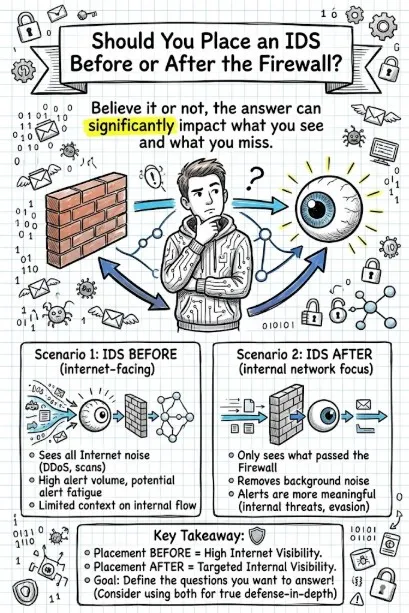

Should You Place an IDS Before or After the Firewall?
Believe it or not, the answer can significantly impact what you see and what you miss.
Many organizations deploy an Intrusion Detection System (IDS) before the firewall.
Why?
Because they want visibility into all incoming traffic, including attacks that are eventually blocked by the firewall.
By placing the IDS before the firewall, you can observe:
- Port scans
- Exploit attempts
- Malware traffic
- Denial-of-Service attempts
- Other malicious activities targeting your network
This gives you valuable threat intelligence and helps you understand what attackers are trying to do.
But there is a trade-off.
Since the IDS sees everything, it generates:
- Huge amounts of traffic
- More alerts
- A higher number of false positives
Now, some organizations place the IDS after the firewall.
Why?
Because they are interested in seeing only the traffic that the firewall has allowed into the internal network.
In this case, the IDS helps answer questions like:
- Is the firewall allowing suspicious traffic?
- Are malicious activities bypassing the firewall?
- How effective are our firewall rules?
- What threats are reaching our internal systems?
Since the firewall has already filtered out much of the unwanted traffic, the IDS receives less traffic and typically produces fewer false positives.
So, Which Placement Is Better?
It depends on your objective.
If your goal is threat intelligence and understanding all attacks targeting your network, place the IDS before the firewall.
You gain visibility into everything, including traffic that is eventually blocked.
If your goal is cyber defense effectiveness and validating what traffic is actually entering your environment, place the IDS after the firewall.
You can monitor allowed traffic and evaluate the effectiveness of your firewall controls.
In Mature Security Architectures
Many organizations deploy IDS sensors in both locations:
- Before the firewall for visibility and threat intelligence.
- After the firewall to monitor what has passed through the defenses.
Remember:
The best location for an IDS isn't about right or wrong—it's about what question you're trying to answer.