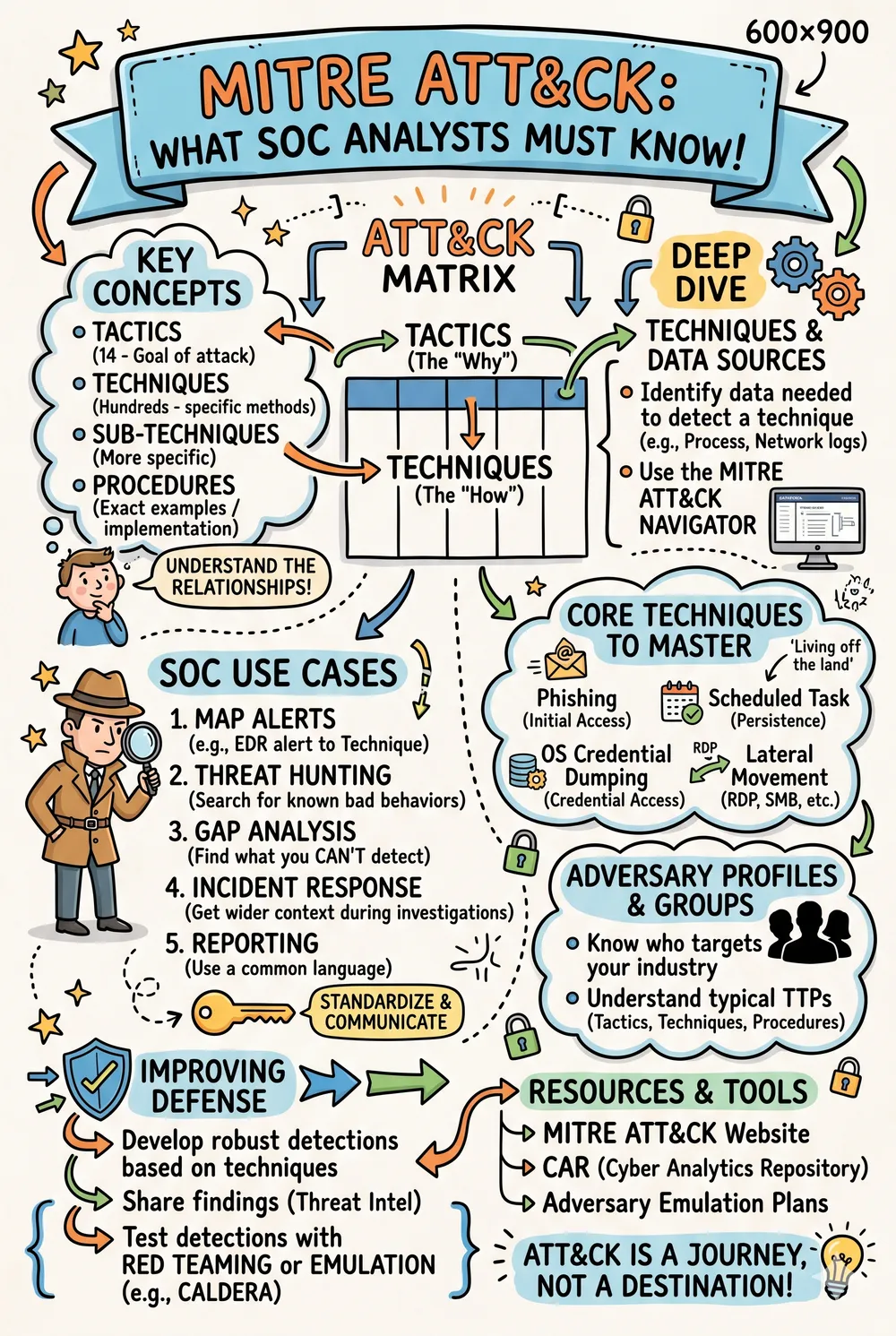

You're Hunting Threats... But You Have No Alerts.
No indicators of compromise.
No malware signatures.
No security alerts.
Just logs... and instinct.
This is where most analysts stop.
The best analysts, however, have a map.
That map is called the MITRE ATT&CK Framework.
And despite what many people think, it is not a security tool, not a scanner, and not an EDR product.
It is a knowledge base that documents how real attackers behave.
Built using intelligence from real-world cyber incidents, nation-state campaigns, Advanced Persistent Threat (APT) groups, and documented attack techniques, it gives defenders a structured way to understand adversary behavior.
How MITRE ATT&CK Is Structured
Think of it in three layers:
1. Tactics – The "Why"
A tactic represents the attacker's objective.
For example:
- Initial Access
- Persistence
- Privilege Escalation
- Lateral Movement
- Exfiltration
These answer the question:
"What is the attacker trying to achieve?"
2. Techniques – The "How"
Techniques explain how attackers accomplish a tactic.
For example, to achieve Persistence, an attacker may use:
- Scheduled Tasks
- Registry Run Keys
- Services
3. Sub-Techniques – The Exact Move
Sub-techniques provide even more detail.
For example:
An attacker wants Persistence (Tactic).
They create a Scheduled Task (Technique).
They use a specific method such as Task Scheduler utilities or command-line tools (Sub-Technique).
Now you know exactly:
- What to hunt for
- Which logs to collect
- Which detections to build
- Which SIEM rules to create
Why MITRE ATT&CK Is So Powerful
1. Structured Threat Hunting
Instead of randomly searching through logs, you can form a hypothesis based on a known technique.
For example:
"What if an attacker is using Scheduled Tasks for persistence?"
Now you can specifically hunt for evidence of that technique.
Threat hunting becomes repeatable, measurable, and systematic.
2. Find Detection Gaps
Map your existing SIEM, EDR, and detection rules against MITRE ATT&CK techniques.
The techniques with no coverage reveal your blind spots.
And today's blind spot is often tomorrow's breach.
3. Understand Your Adversaries
MITRE profiles many threat actors and groups.
Examples include:
- APT29
- Lazarus Group
- FIN7
Their tools, techniques, procedures, and behavior patterns are documented.
Instead of guessing who attacked you, you can compare observed activity with known adversary fingerprints.
A Practical Example
Suppose a competitor in your industry suffers a cyberattack.
The incident report reveals the attacker's:
- Tactics