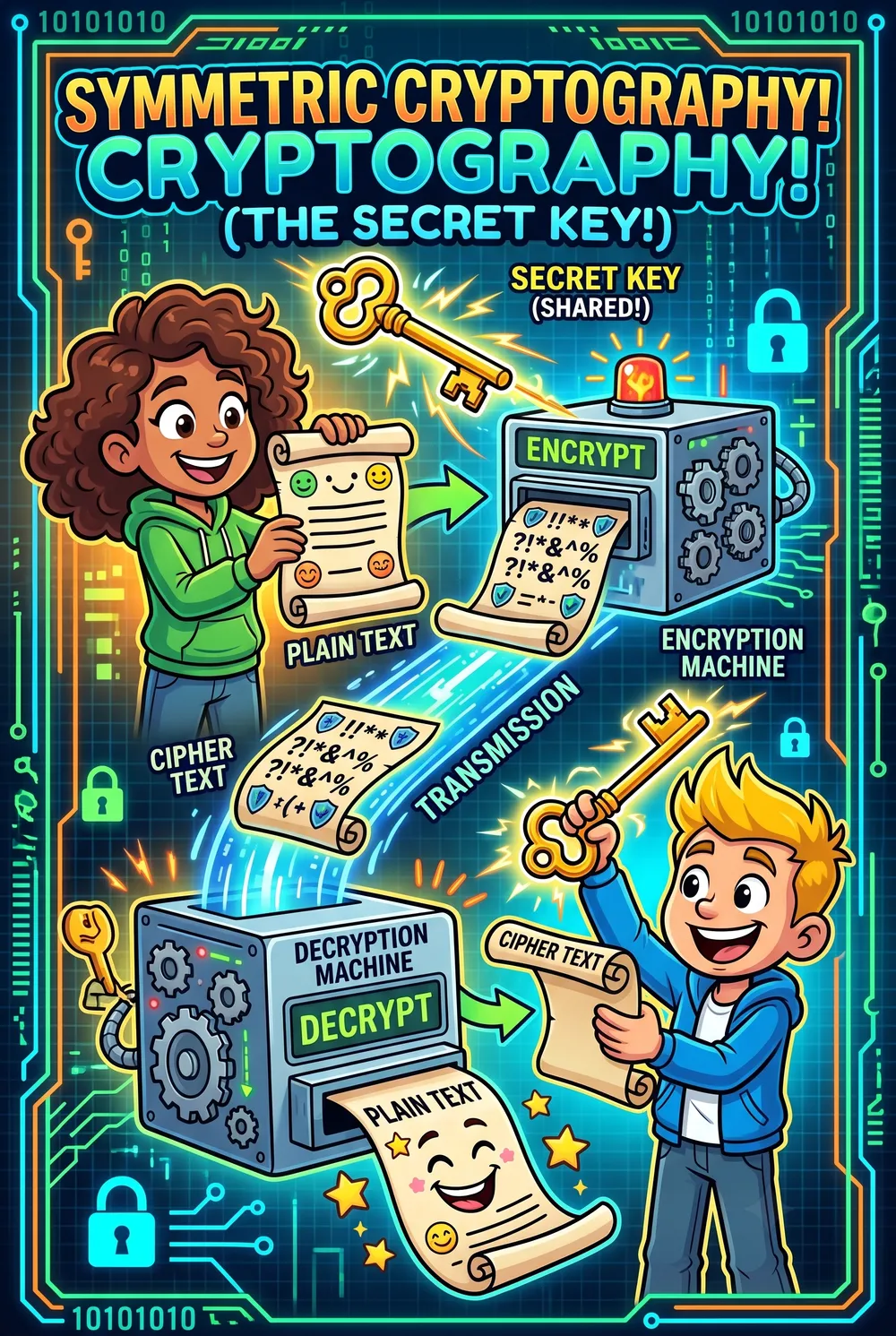

Understanding Symmetric Cryptography with a Simple Locker Example
Imagine you and your friend share a locker.
Both of you have the same key.
You use that key to lock the locker, and your friend uses the same key to unlock it.
Simple. Fast. Convenient.
Cybersecurity uses a very similar concept, and that's where Symmetric Cryptography comes in.
In symmetric encryption, the same secret key is used for both:
- Encrypting data
- Decrypting data
Let's take a simple example.
Suppose I want to send you a confidential file.
Before sending it, I encrypt the file using a secret key.
When you receive the file, you use that same secret key to decrypt it and read the contents.
Because only one key is involved, symmetric encryption is extremely fast and efficient.
That is why it is widely used for protecting large amounts of data.
Where Is Symmetric Cryptography Used?
You use it every day without even realizing it:
- Disk Encryption
- Database Encryption
- VPN Connections
- Wi-Fi Security
- TLS Session Encryption
- File Encryption
The biggest advantage of symmetric cryptography is speed.
It can encrypt and decrypt data much faster than asymmetric cryptography.
But There Is One Major Challenge
How do we securely share the secret key?
Think about it.
If an attacker somehow obtains the secret key, they can decrypt every message protected by that key.
This is known as the Key Exchange Problem.
A good analogy is the old banking process where a credit card and its PIN were delivered separately. If both reached the wrong person, the account could be compromised.
The same challenge exists in symmetric cryptography.
If the key is intercepted while being shared, the security is lost.
So How Do We Solve This Problem?
There are two common approaches:
- Use Asymmetric Cryptography to securely exchange the symmetric key.
- Use an Out-of-Band Channel, such as a separate communication method, to share the key.
This is why modern security systems combine both symmetric and asymmetric cryptography.