
Imagine you want to send money to someone.
To do that, you need the recipient's UPI ID or UPI number. Once you send the payment, the recipient uses their 4-digit UPI PIN to access and authorize transactions securely.
While this is not exactly how cryptography works, it provides a simple analogy for understanding Asymmetric Cryptography.
In asymmetric cryptography, there are two keys:
- Public Key
- Private Key
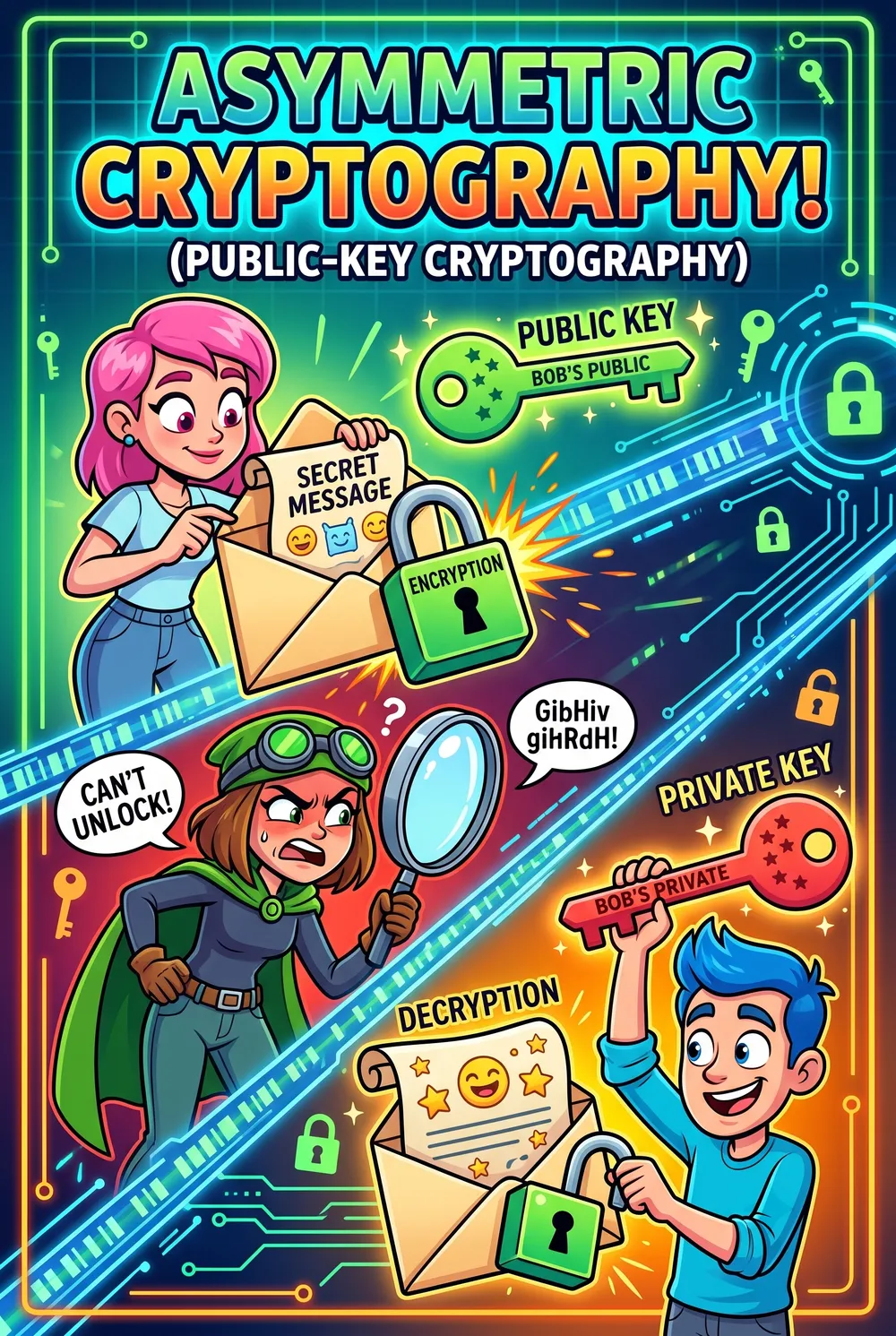
The Public Key is used to encrypt data and can be shared with anyone.
The Private Key is used to decrypt data and must always remain secret.
Let's take a practical example.
Suppose you want to send me some sensitive information, and you want to ensure that only I can read it.
In that case, you would use my Public Key to encrypt the data before sending it.
Once I receive the encrypted data, I use my Private Key to decrypt and read it.
Now, imagine a hacker intercepts the data while it is traveling across the network.
Even if the attacker captures the encrypted data, they cannot read it because they do not possess my Private Key.
This is how asymmetric cryptography ensures confidentiality and secure communication.
But How Is It Used in Real Life?
In real-world systems such as HTTPS, SSL/TLS, VPNs, and secure banking applications, asymmetric cryptography is usually combined with Symmetric Cryptography.
Why?
Because each approach solves a different problem.
Symmetric Cryptography
- Uses the same key for encryption and decryption.
- Very fast.
- Efficient for encrypting large amounts of data.
- Main challenge: Securely exchanging the key.
Asymmetric Cryptography
- Uses Public and Private Keys.
- Solves the key exchange problem.
- More secure for establishing trust.
- Much slower than symmetric cryptography.
To get the best of both worlds, modern systems combine them.
How the Combination Works
- I generate a random Session Key (a symmetric key).
- I encrypt this Session Key using your Public Key.
- I send the encrypted Session Key to you.
- You use your Private Key to decrypt and recover the Session Key.
- Now both of us possess the same Session Key securely.
- From this point onward, all actual data communication is encrypted and decrypted using the Session Key.
This approach provides:
✅ Secure key exchange through Asymmetric Cryptography
✅ Fast data encryption through Symmetric Cryptography
This is exactly how modern secure communications such as HTTPS, SSL/TLS, online banking, and secure websites protect data over the internet.